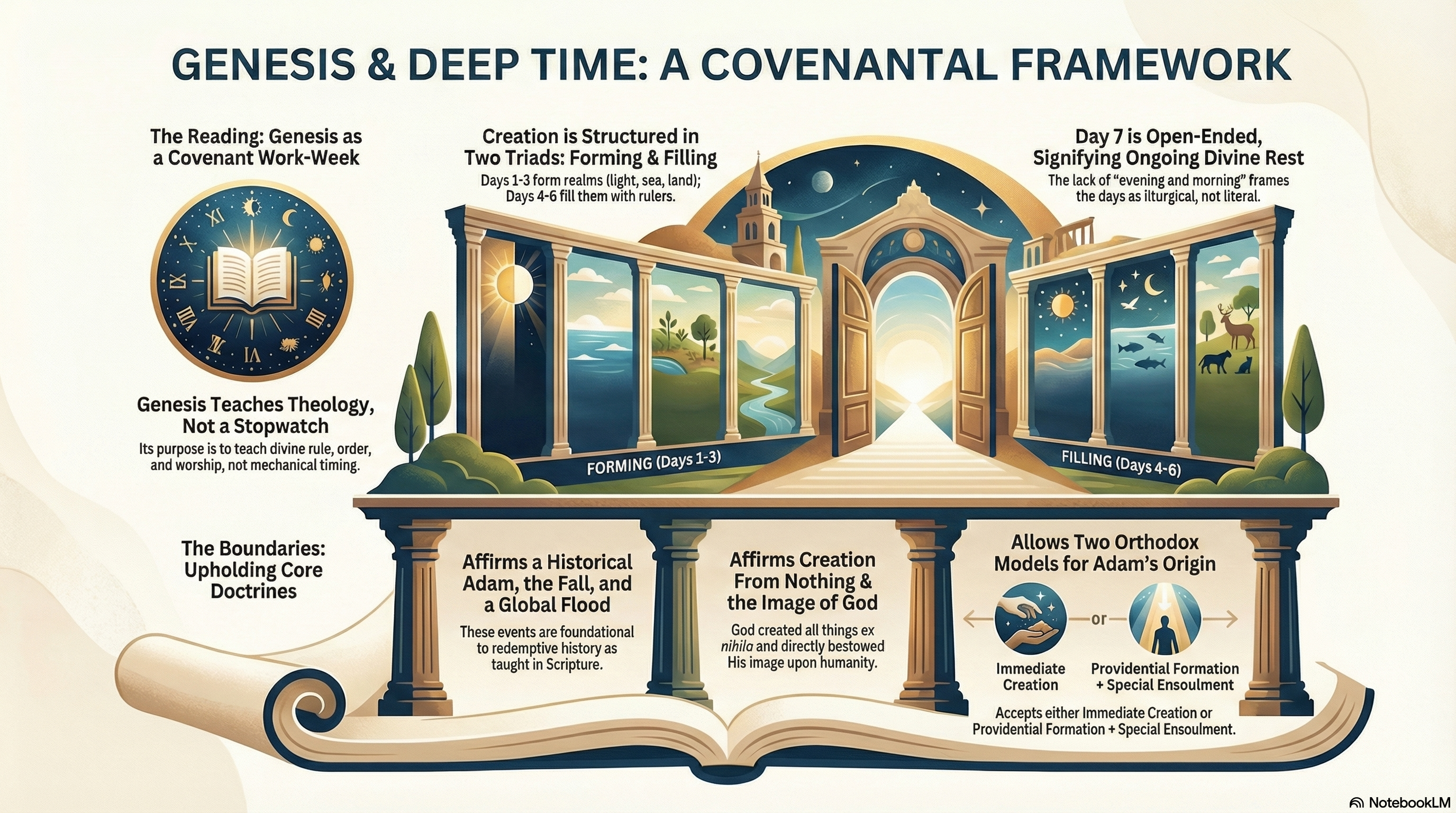
I affirm the inerrancy and sufficiency of Scripture. God created all things ex nihilo—“In the beginning God created the heaven and the earth” (Gen 1:1); “Through faith we understand that the worlds were framed by the word of God” (Heb 11:3). Read on its own terms, Genesis 1 is a covenantal work‑week presentation—real divine acts arranged as six divine workdays culminating in Sabbath enthronement (Gen 2:2–3; Exod 20:8–11; 31:13–17; Heb 4). The text’s purpose is to teach rule, order, and worship, not to provide a mechanical stopwatch. Therefore, receiving an ancient cosmos as descriptive timing for God’s handiwork does not threaten biblical authority (Ps 19:1). Within these bounds we confess a historical Adam and Eve, the direct conferral of the image of God and breath of life (Gen 2:7), Adam’s federal headship and a real Fall (Rom 5; 1 Cor 15), and a global Flood (Gen 6–9; 2 Pet 3:6).
We begin with exegesis—grammar, structure, and canonical context—before asking how Scripture relates to observations of creation.
Guardrails
Implication: With these non‑negotiables in place, believers may evaluate descriptive claims about timing in God’s world without capitulating on theology or history.
Conclusion: Genesis presents analogical workdays—God’s archetypal pattern grounding our weekly rhythm—without requiring human‑length solar days.
God acts extraordinarily (miracles) and ordinarily (providence). “The lot is cast into the lap; but the whole disposing thereof is of the LORD” (Prov 16:33). If He orders lots and kings, He may govern biological processes without ceasing to be Creator. “One day is with the Lord as a thousand years, and a thousand years as one day” (2 Pet 3:8; cf. Ps 90:4) cautions humility about divine days.
God formed man of the dust and breathed life so that man became a living soul (Gen 2:7). Humanity alone bears the imago Dei (Gen 1:26–27) with a royal‑priestly vocation.
Within historic Reformed bounds, two admissible models preserve these truths:
In both, Adam is historical, the Fall is real, and the imago is bestowed, not emergent (1 Cor 15:47).
To clarify this terminology: "Providential Formation" suggests God used ordinary, guided natural processes (what science might observe as evolution) to prepare Adam's physical form from "the dust." "Special Ensoulment" refers to the subsequent, extraordinary act where God directly imparted the "breath of life" (Genesis 2:7)—the rational soul, the imago Dei—and established Adam as the covenantal head of humanity. This model therefore distinguishes the historical Adam from any pre-Adamic hominids, who would have been creatures without the divine image or federal status.
After exegesis, we ask: What does God’s world say about timing? Observations of starlight, stellar lifecycles, and galactic structures point to deep time. Receiving that timing does not rewrite Genesis, because Genesis proclaims who created and why. Thus:
“Death before the Fall?” Scripture ties Adam’s sin to human death and the ground’s curse (Rom 5; Gen 3). Many orthodox old‑earth readings allow animal predation while insisting human death and covenant curse arrive with Adam.
“Does analogical day undermine inerrancy?” No. Inerrancy binds us to what the text intends to assert. If the intent is a work‑week analogy that grounds Sabbath, reading it that way is fidelity, not evasion.
“Isn’t this accommodating science?” Not if the interpretive move is made from the text outward. The analogical/framework reading stands on literary features; scientific descriptions then speak to timing, not theology.
“What about the Flood?” Scripture teaches a global judgment in Noah’s day and an abiding Noahic covenant (Gen 6–9; 2 Pet 3:6). This confession does not hinge on any one post‑Flood geologic model.
“Do genealogies fix earth’s age?” Biblical genealogies often telescope to trace covenant lineage, not to yield exhaustive chronologies.
Within the Reformed Covenant boundaries above: creation ex nihilo (Gen 1:1; Heb 11:3); a real Adam and Eve in God’s image (Gen 1:26–27); God’s special act of breathing life (Gen 2:7); a Covenant of Works and the Fall with death through Adam (Rom 5); salvation in the last Adam, Jesus Christ (1 Cor 15). On the mechanism of human biological origins, Scripture binds us to a historical Adam under God’s special action; Christians may charitably differ whether God formed the human body immediately (special creation of an original pair) or mediately (providentially over time) with special appointment/ensoulment of Adam and Eve. In all cases, the imago Dei is directly conferred by God, Adam’s federal headship is real, and the Fall is historical.
The analogical / framework interpretation, read through a Reformed Covenant lens, is a robust and confessional way to affirm everything Genesis teaches and to receive what the heavens and earth describe about deep time. This is exegesis first, then synthesis—Scripture and nature speaking in harmony, to the glory of the one Creator and Redeemer.
0:{"buildId":"dBupw7NhcwHQYJ3xpO0N4","rsc":["$","$1","c",{"children":[["$","$L2",null,{"topic":{"slug":"genesis-days-and-deep-time-in-a-reformed-covenant-reading","title":"Genesis “Days” & Deep Time in a Reformed Covenant Reading","description":"I affirm the **inerrancy and sufficiency of Scripture**. **God created all things *ex nihilo***—“**In the beginning God created the heaven and the earth**” (Gen 1:1); “**Through faith we understand that the worlds were framed by the word of God**” (Heb 11:3). Read on its own terms, Genesis 1 is a **covenantal work‑week presentation**—real divine acts arranged as **six divine workdays** culminating in **Sabbath enthronement** (Gen 2:2–3; Exod 20:8–11; 31:13–17; Heb 4). The text’s purpose is to **teach rule, order, and worship**, not to provide a mechanical stopwatch. Therefore, receiving an **ancient cosmos** as descriptive timing for God’s handiwork does **not** threaten biblical authority (Ps 19:1). Within these bounds we confess a **historical Adam and Eve**, the **direct conferral of the image of God** and **breath of life** (Gen 2:7), **Adam’s federal headship** and a **real Fall** (Rom 5; 1 Cor 15), and a **global Flood** (Gen 6–9; 2 Pet 3:6).","sourceDirectory":"src/16","inlineEmbeds":[{"href":"https://notebooklm.google.com/notebook/c36c68e2-8e03-4b52-b2da-d42e67f42655?artifactId=78acaf25-8939-4f58-a919-fa5cc0dcb979","label":"Audio Overview","kind":"audio-overview"},{"href":"https://youtu.be/7Xn5e2vi9a0","label":"Video Overview","kind":"video-overview"}],"sections":[{"slug":"genesis-days-and-deep-time-in-a-reformed-covenant-reading","title":"Genesis “Days” & Deep Time in a Reformed Covenant Reading","description":"I affirm the **inerrancy and sufficiency of Scripture**. **God created all things *ex nihilo***—“**In the beginning God created the heaven and the earth**” (Gen 1:1); “**Through faith we understand that the worlds were framed by the word of God**” (Heb 11:3). Read on its own terms, Genesis 1 is a **covenantal work‑week presentation**—real divine acts arranged as **six divine workdays** culminating in **Sabbath enthronement** (Gen 2:2–3; Exod 20:8–11; 31:13–17; Heb 4). The text’s purpose is to **teach rule, order, and worship**, not to provide a mechanical stopwatch. Therefore, receiving an **ancient cosmos** as descriptive timing for God’s handiwork does **not** threaten biblical authority (Ps 19:1). Within these bounds we confess a **historical Adam and Eve**, the **direct conferral of the image of God** and **breath of life** (Gen 2:7), **Adam’s federal headship** and a **real Fall** (Rom 5; 1 Cor 15), and a **global Flood** (Gen 6–9; 2 Pet 3:6).","contentHtml":"$3","inlineEmbeds":[{"href":"https://notebooklm.google.com/notebook/c36c68e2-8e03-4b52-b2da-d42e67f42655?artifactId=78acaf25-8939-4f58-a919-fa5cc0dcb979","label":"Audio Overview","kind":"audio-overview"},{"href":"https://youtu.be/7Xn5e2vi9a0","label":"Video Overview","kind":"video-overview"}],"markdownPath":"src/16/Genesis Days and Deep Time in a Reformed Covenant Reading.md","audio":[{"label":"Genesis_and_Deep_Time_Resolution.m4a","relativePath":"16/Genesis_and_Deep_Time_Resolution.m4a","absolutePath":"/home/temp/src/16/Genesis_and_Deep_Time_Resolution.m4a","publicPath":"/static/topics/16/Genesis_and_Deep_Time_Resolution.647916474a51.m4a","missing":false}],"images":[{"label":"The Genesis Covenantal Framework.png","relativePath":"16/The Genesis Covenantal Framework.png","absolutePath":"/home/temp/src/16/The Genesis Covenantal Framework.png","publicPath":"/static/topics/16/The Genesis Covenantal Framework.40accd400c3a.png","missing":false}],"youtube":["https://youtu.be/7Xn5e2vi9a0"]}],"meta":{"seriesOrAuthor":null,"date":null},"primary":{"playlist":null,"shortVersion":null,"videoOverview":"https://youtu.be/7Xn5e2vi9a0"}},"navigation":{"previous":{"slug":"stop-the-atheism-factory","title":"Stop the Atheism Factory"},"next":{"slug":"covenant-theology-and-the-end-times","title":"Covenant Theology and the End Times: A Vision from Scripture"}}}],["$L4","$L5"],"$L6"]}],"loading":null,"isPartial":false} 4:["$","script","script-0",{"src":"/_next/static/chunks/582fcad204626214.js","async":true}] 5:["$","script","script-1",{"src":"/_next/static/chunks/dc3071b92ac8713b.js","async":true}] 6:["$","$L7",null,{"children":["$","$8",null,{"name":"Next.MetadataOutlet","children":"$@9"}]}] 9:null