By Adam Malin Date: August 12, 2025
Scripture interpreting Scripture establishes that the Reformed doctrine of salvation accords with the Bible’s clearest didactic loci—John 6; Romans 8–9; Ephesians 1; John 10; Jeremiah 31; Ezekiel 36. Within the frame confessed by the Westminster Standards—Holy Scripture as the supreme judge (WCF 1), God’s eternal decree (WCF 3), and the one Covenant of Grace, differently administered under law and gospel (WCF 7.5–6)—God effectually calls, particularly redeems, and preserves His people to the end (WCF 10; 8; 17). The texts themselves teach divine initiative and certainty: the Father gives a people to the Son, the Son redeems them, and the Spirit effectually draws and seals them (John 6:37–45; Romans 8:29–30; Ephesians 1:3–14; John 10:27–29; Jeremiah 31:31–34; Ezekiel 36:26–27, KJV). By confession, God “from all eternity…ordain[s] whatsoever comes to pass” (WCF 3.1) and “neither are any other redeemed by Christ, effectually called… and saved, but the elect only” (WCF 3.6; 10.1).
All Scripture citations are from the KJV.
The method proceeds by (1) reading words in canonical and literary context, (2) prioritizing passages where Scripture directly explains salvation (John 6; Romans 8–9; Ephesians 1; John 10; Ezekiel 36; Jeremiah 31), and (3) harmonizing the universal, sincere gospel offer with God’s particular saving purpose, heeding the Creator–creature distinction: “The secret things belong unto the LORD our God: but those things which are revealed belong unto us…” (Deuteronomy 29:29). The Confession locates such judgments under Scripture’s supremacy: controversies are finally resolved by “the Holy Spirit speaking in the Scripture” (WCF 1).
The Westminster Confession frames salvation covenantally:
Covenant of Works (with Adam). The Confession states: “The first covenant made with man was a covenant of works” (WCF 7.2). By this arrangement life was promised to Adam “upon condition of perfect and personal obedience,” revealing the law’s condemning power apart from grace (cf. Romans 3:20; 5:12–19).
One Covenant of Grace—differently administered. The same gracious covenant runs through redemptive history, administered “under the law” and “under the gospel,” yet “for substance” one and the same (WCF 7.5–6). This affirms continuity from promise to fulfillment in Christ (Galatians 3:8, 16, 29).
Christ the Mediator and Surety. The Confession identifies the Lord Jesus as the Mediator—“to whom…[the Father] did from all eternity give a people, to be his seed; and to be by him in time redeemed, called, justified, sanctified, and glorified” (WCF 8.1). Scripture names Him the “surety of a better testament” (Hebrews 7:22), grounding particular redemption and its certain application (John 10:11, 27–29).
The visible church and the covenant line. The visible Church “consists of all throughout the world that profess the true religion, together with their children,” the house and family of God under Christ’s kingship (WCF 25.2). This expresses the covenant’s household scope in the administration of the gospel.
Sacraments across the ages. The Confession teaches sacramental unity: “The sacraments of the Old Testament…were, for substance, the same with those of the New” (WCF 27.5). Hence baptism succeeds circumcision as the initiatory sign of covenant membership; accordingly, “not only those that do actually profess faith… but also the infants of one, or both, believing parents are to be baptized” (WCF 28.4) (cf. Genesis 17:7; Acts 2:39; Colossians 2:11–12).
Why this matters for soteriology. Read within this covenantal frame, the doctrines of election, redemption, effectual calling, and perseverance remain centered on Christ’s mediatorship and the triune decree. The Confession explicitly ties decree to means: those elected “are redeemed by Christ… effectually called… justified, adopted, sanctified, and kept by His power” (WCF 3.6). Effectual calling is applied by Word and Spirit—enlightening the mind, removing the heart of stone, and renewing the will (WCF 10.1; John 6:37–45; Ezekiel 36:26–27). Preservation is certain: “They… can neither totally nor finally fall away… but shall certainly persevere… and be eternally saved” (WCF 17.1; John 10:27–29; Romans 8:30).
What the text says. Scripture teaches that fallen man is dead in sin and unable to receive spiritual truth apart from sovereign grace: “And you hath he quickened, who were dead in trespasses and sins” (Ephesians 2:1–3); “the natural man receiveth not the things of the Spirit of God… neither can he know them” (1 Corinthians 2:14); “There is none that seeketh after God” (Romans 3:11). Regeneration is monergistic: believers are “born… of God” (John 1:13), and the Spirit’s life-giving work is sovereign and prior, “like” the wind (John 3:5–8).
Implication. Because man cannot come, salvation begins with God’s initiative according to covenant promise: “A new heart also will I give you… and I will cause you to walk in my statutes” (Ezekiel 36:26–27).
Clarification (accountability ≠ ability). General revelation leaves all men “without excuse” (Romans 1:20), yet does not impart saving ability. Jeremiah 29:13 addresses covenant exiles and promises restoration within that covenant context. Titus 2:11’s grace that has “appeared to all men” stands within a paragraph enumerating all sorts of persons (Titus 2:1–10); the saving “teaching us” is directed to believers. None of these texts overturn the doctrine of inability (Ephesians 2:1–3; 1 Corinthians 2:14).
What the text says. Election is eternal, gracious, and sovereign: God “hath chosen us in him before the foundation of the world… having predestinated us… according to the good pleasure of his will” (Ephesians 1:4–5, 11). The apostolic argument locates the cause in God’s purpose, not human works: before birth, “that the purpose of God according to election might stand… The elder shall serve the younger… I will have mercy on whom I will have mercy” (Romans 9:11–16, 18). Election issues in faith: “as many as were ordained to eternal life believed” (Acts 13:48). Those whom the Father gives to the Son come (John 6:37, 39, 44).
Foreknowledge in Romans 8. The “golden chain” binds the same people from foreknowledge to glorification: “For whom he did foreknow, he also did predestinate… moreover whom he did predestinate, them he also called… justified… glorified” (Romans 8:29–30). If “foreknow” were bare foresight of all persons, the chain would entail universal salvation. Scripture uses “know” covenantally and personally (e.g., “You only have I known,” Amos 3:2); thus foreknowledge = fore-love of a people in Christ.
Common objections answered. “Whosoever believeth” (John 3:16) states the instrument of reception, not the cause of God’s choice; Calvinism gladly affirms that all who believe are saved, and John 6:37 explains why they believe (the Father gives and draws). In 1 Timothy 2:4, “all men” occurs within an exhortation to pray “for all… for kings” (1 Timothy 2:1–2), naturally indicating all sorts/classes, not every individual without exception. In 2 Peter 3:9, the patience of God is directed “to us-ward” (the beloved; 2 Peter 3:1, 8–9), i.e., that none of His people will perish. Second Peter 1:10 urges the pursuit of assurance by fruit, not that diligence causes election. Romans 10:13’s “whosoever shall call” is true, and the Apostle immediately ties such calling to God-ordained means (Romans 10:14–17). A strictly corporate-only reading of Romans 9 fails to account for the Apostle’s explicit focus on individuals (Isaac/Ishmael; Jacob/Esau) and his potter-clay argument (Romans 9:18–23).
A fuller treatment appears in Predestination, “All,” and a Definite Gospel: https://hedgedoc.malin.onl/s/GhrguFa9T
Election positive; reprobation by preterition. Scripture teaches an asymmetry in God’s decree. Election is positive and gracious: God effectually grants new hearts, repentance, and faith to the elect (Ezekiel 36:26–27; Philippians 1:29; John 6:37). With respect to the rest, God passes over—leaving them to their chosen darkness—and He judges for their sin (John 3:19; Romans 2:5–8). This preserves the holiness of God: He is not the author of sin (James 1:13; 1 John 1:5). He hardens judicially and righteously (Romans 9:18), while sinners freely love the darkness they have chosen (John 3:19).
Romans 9 in focus. The Apostle anticipates the charge of unfairness and answers by asserting God’s sovereign right as Potter, together with the reality that vessels of wrath are endured “with much longsuffering” and are “fitted to destruction” in relation to their sin, whereas vessels of mercy are prepared by God for glory (Romans 9:18–23). The text holds together divine freedom and human responsibility without confusion.
What the text says. Scripture locates the design of Christ’s death in the actual salvation of a particular people: “he shall save his people from their sins” (Matthew 1:21); the Shepherd “giveth his life for the sheep” (John 10:11, 15); Christ “loved the church, and gave himself for it” (Ephesians 5:25). Atonement and intercession are coextensive: those for whom He died are those for whom He pleads, the elect against whose charge none can stand (Romans 8:33–34; cf. John 17:9).
Universal language in context. “World” (John 3:16) heralds the worldwide reach of God’s saving purpose—beyond Israel to the nations. “Propitiation… for the sins of the whole world” (1 John 2:2) assures that Christ’s propitiation extends beyond the immediate audience to every nation (John 11:51–52; Revelation 5:9), not that each individual is actually propitiated (which would entail universalism). “I… will draw all men” (John 12:32) appears as Greeks seek Jesus (John 12:20–21), signaling all kinds—Jew and Gentile. In classic terms, the atonement is sufficient for all and efficient for the elect; and Scripture binds the efficacy of His death to the scope of His intercession (Romans 8:32–34; John 17:9).
Payoff. Where Christ has borne guilt, God does not require its payment twice. “There is therefore now no condemnation” for those in Him, because the cross and advocacy secure their standing (Romans 8:1, 32–34). Assurance rests on the cross’s effectiveness, not on fluctuating emotion.
What the text says. Scripture declares that those given by the Father to the Son shall come to Him, and none who come are cast out (John 6:37). The same ones who are drawn are “raised up at the last day,” identifying a saving draw inseparable from final glory (John 6:44). In this saving call, justification follows necessarily (Romans 8:30). The narrative example accords: the Lord opened Lydia’s heart so that she attended to the apostolic word (Acts 16:14).
On “draw” (helkō). In John 6:44 the verb denotes a decisive pull that secures the result in view—“and I will raise him up at the last day.” Its ordinary usage confirms a compelling action (John 21:6, 11; Acts 16:19; James 2:6); thus those drawn in this sense come and are kept.
Resisting and the two calls. Men “do always resist the Holy Ghost” in the external call (Acts 7:51); yet the internal call overcomes resistance by new-covenant efficacy: God writes His law on the heart and effectually brings His people to the knowledge of Himself (Jeremiah 31:33–34; Hebrews 8:10–11).
What Scripture teaches. Christ guarantees the final safety of His own: “My sheep hear my voice… and they shall never perish; neither shall any man pluck them out of my hand… [nor] out of my Father’s hand” (John 10:27–29). Believers are “kept by the power of God through faith unto salvation” (1 Peter 1:5). The same people are foreknown, predestined, called, justified, and glorified—an unbroken golden chain (Romans 8:29–30).
What Westminster affirms. All truly united to Christ “can neither totally nor finally fall away,” but shall certainly persevere, their preservation resting on God’s eternal love in election, Christ’s merit and intercession, the Spirit’s indwelling, and the covenant of grace (WCF 17.1). Yet real believers may, through temptation, remaining corruption, and neglect of the appointed means, fall into grievous sins for a time; God recovers them by fatherly chastening, so they are not utterly cast down (WCF 17.3).
How the warning texts function. Hebrews speaks of those who have tasted covenant privileges and then fall away (Hebrews 6:4–6). John explains such departures: “They went out from us, but they were not of us” (1 John 2:19). These warnings are among the means God uses to keep His people watchful and dependent; they do not annul Christ’s promise to preserve His sheep or the Father’s power to keep them.
Bottom line. Perseverance is God’s work in His saints, through faith and by His appointed means; therefore no true believer will finally be lost (John 10:27–29; 1 Peter 1:5; WCF 17).
Sincere, universal offer. Scripture declares a genuine offer to every creature: “whosoever will, let him take the water of life freely” (Revelation 22:17; cf. Mark 16:15; John 3:16; Romans 10:13). All who come are received without exception (John 6:37). Compatibilism explains why any will come: God makes His people willing in the day of His power (Psalms 110:3), opening the heart to attend the Word (Acts 16:14).
Means matter. God ordains means as well as the end: preaching, prayer, evangelism, and discipleship are appointed instruments (Romans 10:14–17; 1 Corinthians 1:21). The apostolic pattern is missional, not fatalistic: “I endure all things for the elect’s sakes, that they may also obtain the salvation” (2 Timothy 2:10). Election fuels the work; it never replaces it.
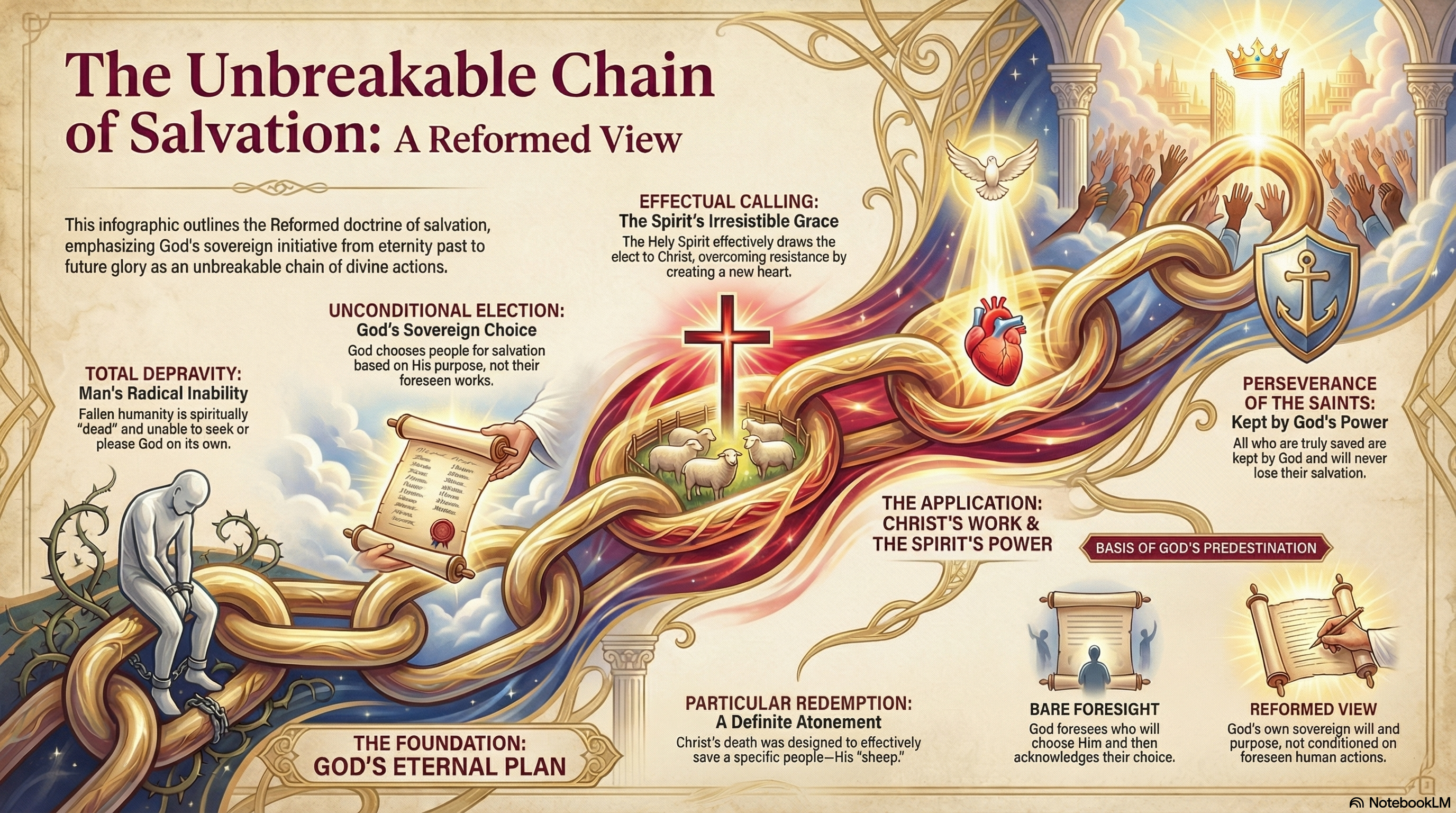
Bare Foresight View. This view asserts that God merely foresees future human choices and then “predestines” by acknowledging them.
Westminster (Reformed) View. God’s decree is not conditioned on foreseen acts: He “hath not decreed any thing because He foresaw it as future, or as that which would come to pass upon such conditions,” but “worketh all things after the counsel of His own will” (WCF 3.2; cf. Ephesians 1:11). Those foreknown are predestined, effectually called, justified, and glorified (WCF 10.1; Romans 8:29–30).
John 3:16. “Whosoever believeth” identifies the instrument of reception, not the cause of believing. The apostolic witness explains the cause elsewhere: those who believe do so because the Father gives them to the Son and draws them effectually (John 6:37, 44).
2 Peter 1:10. “Make your calling and election sure” addresses assurance by fruit, not the causation of election. Scripture grounds the decree solely in God’s purpose of grace, not in human diligence (Ephesians 1:4–5; 2 Timothy 1:9).
Romans 10:13. “Whosoever shall call upon the name of the Lord shall be saved” is immediately joined to God-ordained means: preaching heard and believed (Romans 10:14–17). The heart’s receptivity is God’s gift, as exemplified in Lydia, “whose heart the Lord opened” (Acts 16:14).
Romans 9. Paul’s burden concerns persons (Romans 9:1–3). He reasons from individuals—Isaac and Ishmael, Jacob and Esau—and concludes, “not of him that willeth, nor of him that runneth, but of God that sheweth mercy” (Romans 9:16). Corporate blessing flows from God’s prior choice of people; the potter-clay image underscores unconditional mercy and sovereign hardening (Romans 9:18–23).
1 John 2:2. “Not for ours only, but also for the sins of the whole world” assures that Christ’s propitiation extends beyond the immediate audience to all nations (cf. John 11:51–52; Revelation 5:9). It does not teach that each individual is actually propitiated, which would entail universal salvation.
John 1:29; John 3:16–17. These texts herald the worldwide scope of Christ’s mission. The Reformed reading affirms the atonement’s sufficiency for all and its efficacy for the elect (John 10:11, 15; Matthew 1:21; Ephesians 5:25).
John 12:32. “I… will draw all men” appears as Greeks come seeking Jesus (John 12:20–21) and naturally signifies all kinds—Jew and Gentile. John’s usage of helkō elsewhere denotes a decisive draw (John 6:44; 21:6, 11; cf. Acts 16:19; James 2:6).
Two calls. The external call of the gospel can be and often is resisted (Acts 7:51); the internal call issued in God’s time results in faith and justification (Romans 8:30; John 6:37). This is illustrated when “the Lord opened” Lydia’s heart to heed the preached Word (Acts 16:14).
Matthew 23:37. “How often would I… and ye would not” rebukes Jerusalem’s leaders whose hardness hindered thy children (those under their care). The lament indicts covenant leadership; it does not overturn the promise that all whom the Father gives to the Son shall come (John 6:37).
Hebrews 6:4–6. The description concerns those who tasted covenant privileges and then fell away. John interprets such departures: “They went out from us, but they were not of us” (1 John 2:19). The warnings are means by which God keeps His own.
Galatians 5:4. “Ye are fallen from grace” denotes a turn from the principle of grace to law for justification, not the loss of regeneration.
Assurance and means. Texts of assurance—Christ’s promise and the Father’s power (John 10:27–29), the unbreakable chain (Romans 8:29–39), and being “kept by the power of God through faith” (1 Peter 1:5)—establish final preservation. Diligence in godliness (2 Peter 1:10) is the ordained pathway to assurance, not a contingency upon which election depends.
“Salvation is of the LORD” (Jonah 2:9) humbles the proud (1 Corinthians 1:29), steadies the weary (Philippians 1:6), and sends forth the church with confidence: the gospel will gather all whom the Father has given to the Son (John 6:37; Acts 18:10). This is not fatalism; it is the warm engine of missions and holiness.
Measured by strict exegesis and framed by the Westminster Confession of Faith—God’s eternal decree (WCF 3), the one Covenant of Grace “differently administered” under law and gospel (WCF 7), effectual calling (WCF 10), and the certain perseverance of the saints (WCF 17)—Calvinism best accounts for the Bible’s own explanations of salvation. It upholds the free and sincere offer of the gospel to every creature (Mark 16:15) while ascribing all glory to God for every sinner who believes (Ephesians 2:8–9).
Reply. The New Testament locates New-Covenant blessing in the church’s present salvation. The Lord institutes the Supper declaring, “This cup is the new testament in my blood” (Luke 22:20; 1 Corinthians 11:25), identifying His death as the covenant’s ratification for His disciples. Hebrews cites Jeremiah 31:31–34 and concludes that the New Covenant is now enacted and the old made obsolete, “ready to vanish away” (Hebrews 8:6–13; 10:14–18). The apostles describe their ministry as “ministers of the new testament” (2 Corinthians 3:6), placing gospel ministry within the New-Covenant framework. Access is applied to all believers: the church has come “to Jesus the mediator of the new covenant” (Hebrews 12:22–24), and He mediates it “that… the called might receive the promise of eternal inheritance” (Hebrews 9:15). In Christ, Gentiles once “aliens from the commonwealth of Israel” become “one new man” with Jewish believers—“fellowcitizens with the saints, and of the household of God” (Ephesians 2:11–22). Therefore, Jeremiah’s promises—law on the heart, definitive forgiveness, and a people who all know the Lord—are fulfilled in the church through Christ’s blood and the Spirit’s work now, not reserved for a separate future economy (Jeremiah 31:31–34; Hebrews 8:6–13). (Bible Gateway–4, 6–7; Bible Study Tools)
Reply. Scripture describes the realities these terms name. With Adam there is a probationary arrangement—life upon obedience, death upon disobedience (Genesis 2:16–17), later summarized: “The man which doeth those things shall live by them” (Leviticus 18:5; Romans 10:5; Galatians 3:12). Adam’s one trespass condemns many (Romans 5:12–19). After the fall, God promises salvation in Christ (Genesis 3:15), speaks of the “everlasting covenant” in His blood (Hebrews 13:20), and formally establishes the New Covenant (Jeremiah 31; Hebrews 8). The confessional labels identify these textual structures.
Reply. Romans 8:29–30 binds the same group from foreknowledge to glorification; if foreknowledge were mere foresight of all who would believe, the chain would entail universal salvation, which Scripture denies. “Know” frequently signifies covenantal love set upon a people (Amos 3:2). First Peter 1:2 (“elect according to the foreknowledge of God”) ties election immediately to the Spirit’s sanctifying work unto obedience and the sprinkling of Christ’s blood—divine initiative, not man’s foreseen act. “Chosen in him” (Ephesians 1:4) identifies the sphere and Mediator of choice, not a nameless class self-populated by human decision; the passage speaks of persons predestinated, adopted, redeemed, and sealed (Ephesians 1:4–14). Romans 9 presses individual examples (Isaac/Ishmael; Jacob/Esau before doing good or evil) and addresses the fairness objection coherent only if personal salvation is in view (Romans 9:11–16, 18–23).
Reply. Scripture defines the condition as inability: “the natural man receiveth not… neither can he know them” (1 Corinthians 2:14); “the carnal mind is not subject to the law of God, neither indeed can be… they that are in the flesh cannot please God” (Romans 8:7–8). “Dead in trespasses” (Ephesians 2:1–5) is answered by God’s unilateral quickening. In John 6, “draw” is effectual because the one drawn is the one raised (John 6:44, 65 with 6:37–39). John 12:32 (“draw all men”) occurs as Greeks approach (John 12:20–21), signaling all kinds (Jew and Gentile), not every individual without exception. Titus 2:11 stands amid “all sorts” (Titus 2:1–10); the saving “teaching us” (Titus 2:12) addresses believers.
Reply. John 1:12–13 links receiving Christ to the prior cause—new birth “not of the will of man, but of God.” The Lord opens the heart so that the word is heeded (Acts 16:14). Ephesians 1:13 gives the order of experience (hearing, believing, sealing), not the cause of life from above; the Spirit’s renewing work enables faith (Ezekiel 36:26–27; John 3:5–8). Regeneration and faith are inseparable; regeneration is the root, faith the first act.
Reply. Scripture supports the classical distinction: sufficiency for all, efficiency for the elect.
Reply. The gospel offer publishes God’s revealed will—commanding all to repent and promising that all who come will be saved (Mark 16:15; Acts 17:30; John 6:37; Romans 10:13). The intent of election belongs to God’s secret will (Deuteronomy 29:29). Since the elect are unknown to preachers, the universal call is the ordained means by which they are gathered (Romans 10:14–17; 1 Corinthians 1:21; 2 Timothy 2:10).
Reply. The KJV reads “ordained to eternal life.” The verb tassō denotes setting/appointing (e.g., Luke 7:8). Luke’s theology repeatedly attributes saving response to divine appointment and action (Acts 16:14; 18:10–11). The narrative contrast—some “judged themselves unworthy of everlasting life” (Acts 13:46) while others were “ordained”—highlights God’s gracious appointment of the believing.
Reply. In John 6:44 the one drawn is the one raised up at the last day, matching the certainty of John 6:37 (“shall come”). John’s uses of helkō depict a decisive pull (John 21:6, 11; cf. James 2:6). John 12:32 addresses scope—“all” kinds (Jew and Gentile in the context of Greeks approaching, John 12:20–21)—not universal efficacy for each person.
Reply.
Reply. “No respect of persons” concerns justice—God renders to every man according to his works without regard to face, status, or bribe (Romans 2:6–11). Election is grace, not payment for any trait in the sinner (Romans 11:5–6). Scripture distinguishes common benevolence (Matthew 5:45) from saving, particular love (Deuteronomy 7:7–8; John 13:1; Ephesians 5:25). God’s sovereign right to bestow mercy stands (Romans 9:15, 18).
Reply. Ezekiel 18 rejects penalizing children for their fathers’ sins in civic/judicial spheres. Romans 5:12–19 teaches Adamic federal headship—by one man’s disobedience many were made sinners—answered by Christ the last Adam (cf. 1 Corinthians 15:22). Personal responsibility and federal representation stand together.
Reply. God ordains means as well as ends. Paul endures “for the elect’s sakes” (2 Timothy 2:10). The Lord’s promise of “much people in this city” emboldens preaching (Acts 18:9–11). The Great Commission remains (Mark 16:15); election guarantees mission will not fail, not that mission is needless (Romans 10:14–17).
Reply. Scripture speaks of two senses of “call.” Many are externally called (Matthew 22:14), but only the effectually called come in faith (Romans 8:30; 1 Corinthians 1:23–24). Both are true; the latter forms the “golden chain.”
Reply. Cornelius is a God-fearer under prior grace and special providence; God sovereignly arranges Peter’s gospel so that Cornelius hears and believes (Acts 10–11). Peter interprets the event as God granting repentance to the Gentiles (Acts 11:18), not as unaided human ability.