1:"$Sreact.fragment"
2:I[29599,["/_next/static/chunks/c14ecd726bc2083a.js","/_next/static/chunks/505e4ebfa08d2f59.js","/_next/static/chunks/e4c290a724a96cb5.js","/_next/static/chunks/582fcad204626214.js","/_next/static/chunks/dc3071b92ac8713b.js"],"default"]
7:I[97367,["/_next/static/chunks/ff1a16fafef87110.js","/_next/static/chunks/247eb132b7f7b574.js"],"OutletBoundary"]
8:"$Sreact.suspense"
3:T2661,From Shadow to Substance: Reading Israel’s Prophecies in Light of Christ
Audio Overview
Video Overview
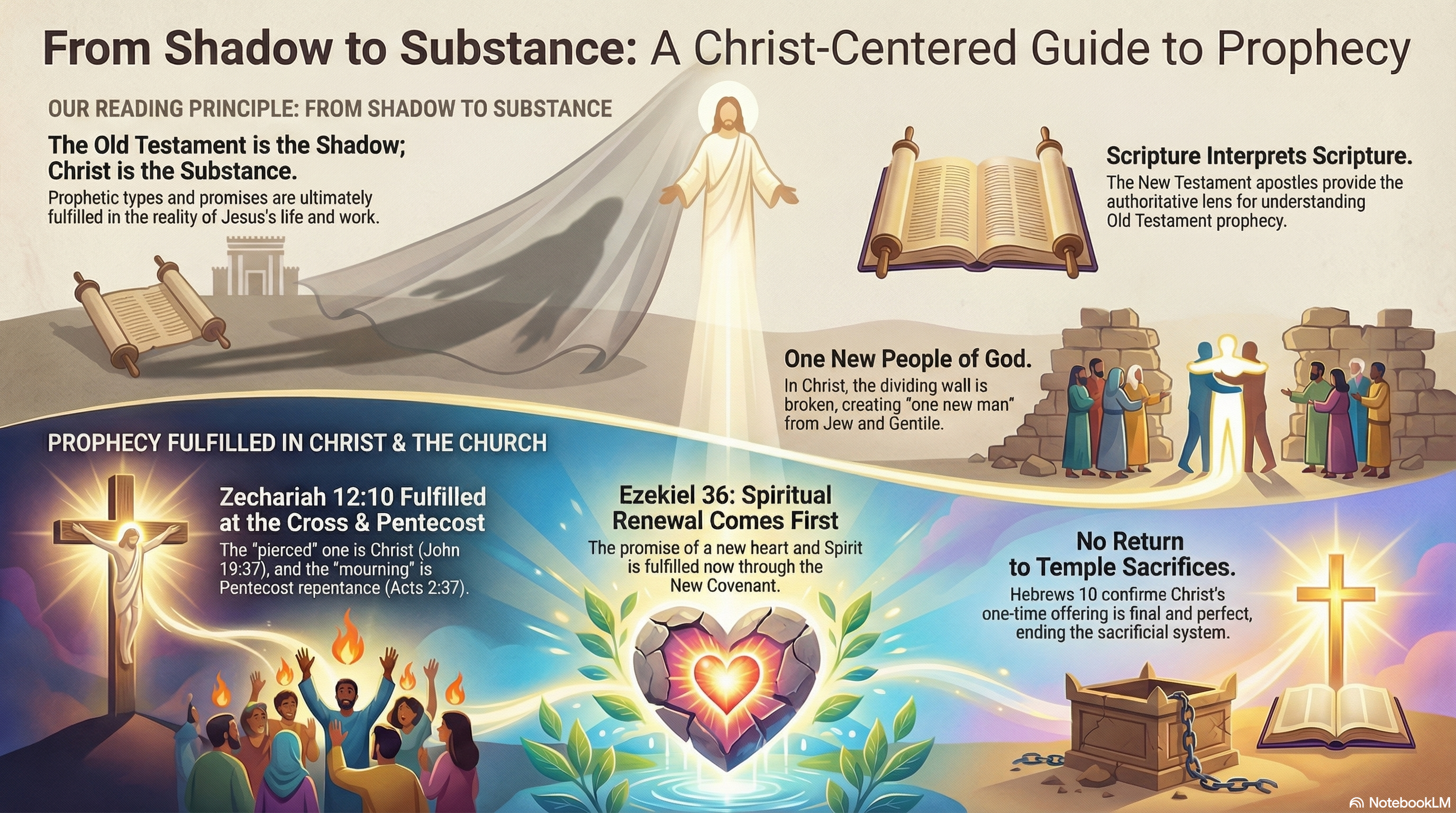
Many sincere believers equate “taking prophecy literally” with faithfulness, yet the apostles teach us to read the Old Testament in the light of Christ and His finished work. This post follows that apostolic pattern: Scripture interprets Scripture; shadow gives way to substance; and in the New Covenant God makes one new man of Jew and Gentile in Christ. We’ll trace how Zechariah 12:10 is fulfilled at the cross and preached at Pentecost, how Ezekiel 36–37 puts new heart and Spirit before any talk of dwelling, why Hebrews rules out any return to temple blood, and how Zechariah 14’s geography doesn’t smuggle in modern political preconditions. The goal is simple and pastoral: to read plainly, reverently, and Christ-centeredly—so that our hope rests not in speculation, but in the Savior who reigns.
Thesis (short and plain)
Scripture interprets Scripture. Prophecy moves from shadow to substance in Christ; the New Covenant reveals what the Old anticipated. Therefore, promises to Israel reach their fulfillment in Christ and His church, the “one new man” of Jew and Gentile together (Ephesians 2:14–16). Some popular “literal” readings add contexts Scripture does not, especially around Zechariah 12–14 and Ezekiel 36–37. Let’s read these passages by the apostolic rule—with Christ at the center, the KJV text in hand, and charity toward our neighbors.
Our Hermeneutic (how we read)
“Comparing spiritual things with spiritual” (1 Corinthians 2:13). The apostles teach us to read the Old by the New.
- Scripture interprets Scripture; the clear governs the hard. “Study to shew thyself approved… rightly dividing the word of truth” (2 Timothy 2:15).
- Shadow → Substance. “Which are a shadow of things to come; but the body is of Christ” (Colossians 2:17).
- One covenant of grace, now in New-Covenant clarity and power. “This is the covenant… I will put my law in their inward parts… for I will forgive their iniquity” (Jeremiah 31:33–34).
- One new people. “For he is our peace, who hath made both one… to make in himself of twain one new man… and… reconcile both unto God in one body by the cross” (Ephesians 2:14–16).
Case Study 1 — Zechariah 12:10 fulfilled in Christ’s first coming and preached at Pentecost
“…they shall look upon me whom they have pierced, and they shall mourn for him…” (Zechariah 12:10)
“And again another scripture saith, They shall look on him whom they pierced.” (John 19:37)
“Therefore let all the house of Israel know assuredly, that God hath made that same Jesus, whom ye have crucified, both Lord and Christ.” (Acts 2:36)
“Now when they heard this, they were pricked in their heart… Then they that gladly received his word were baptized… about three thousand souls.” (Acts 2:37, 41)
John directly applies Zechariah 12:10 to the crucifixion, and Peter’s Pentecost sermon convicts that generation of Israel, yielding mass repentance and baptism. This shows the prophecy’s decisive realization in the cross and the Spirit’s outpouring—not a postponement to a future temple regime.
Case Study 2 — Ezekiel 36–37: New-Covenant cleansing and Spirit before any talk of land
“Then will I sprinkle clean water upon you… A new heart also will I give you… And I will put my spirit within you, and cause you to walk in my statutes.” (Ezekiel 36:25–27)
“This is the covenant… I will put my law in their inward parts, and write it in their hearts… for I will forgive their iniquity.” (Jeremiah 31:33–34)
Ezekiel 36 sets the order: spiritual renewal first (cleansing, new heart, Spirit), then any blessing associated with dwelling. That is the exact sequence Christ inaugurates—His death, resurrection, and Pentecost breathe life into a people who walk in God’s statutes. Reading it this way follows the text’s own “and… then” structure and avoids inserting a gap the passage never states.
Ezekiel 37’s valley of dry bones pictures this Spirit-wrought resurrection life. Christ breathes on His disciples (John 20:22), and at Pentecost the Spirit is poured out—just where Ezekiel’s vision points. The result is a multinational people gathered into one fold under one Shepherd (John 10:16; Matthew 28:18–20).
Takeaway: The New Covenant realities (new heart, Spirit, obedience) are already at work now in Christ’s church. That matches Paul’s “one new man… one body” teaching and guards us from re-erecting a wall Christ tore down (Ephesians 2:14–16).
Case Study 3 — Zechariah 14 and the “nation-state” assumption
Zechariah 14 mentions Jerusalem and the Mount of Olives—real places. But nothing in the text requires a twentieth-century nation-state for Jesus to set foot on the Mount of Olives or to judge the nations. To insist on that is to import extra-biblical context. A truly careful reading lets the prophetic geography stand without smuggling in modern political preconditions.
A pastoral caution about anti-Semitism
We must not speak in ways that blame “all Jews” for Christ’s death across all time; that is neither apostolic nor charitable. Peter addressed a particular audience (“whom ye have crucified,” Acts 2:36) and then immediately preached repentance and life in Christ to them—and thousands believed. The gospel obliterates boasting and prejudice alike.
“For there is no difference between the Jew and the Greek: for the same Lord over all is rich unto all that call upon him.” (Romans 10:12)
Why “no return to temple blood” matters
Hebrews anchors us:
“For by one offering he hath perfected for ever them that are sanctified.” (Hebrews 10:14)
“Now where remission of these is, there is no more offering for sin.” (Hebrews 10:18)
Any scheme that reintroduces sacrificial blood—“memorial” or otherwise—contradicts the finality of Christ’s cross. The New Covenant fulfills the types; we must not turn back to shadows.
Putting it all together (Reformed compass)
- One people of God. In Christ, Jew and Gentile are reconciled “in one body” (Ephesians 2:14–16).
- New-Covenant power now. Ezekiel 36’s cleansing and heart-renewal belong to this gospel age (Jeremiah 31:33–34).
- Prophecy fulfilled in Christ. Zechariah 12:10 is tied to the crucifixion (John 19:37) and realized in Pentecost repentance (Acts 2:36–41).
- No extra contexts. Don’t add a nation-state precondition to Zechariah 14 that the text never states.
How to teach this (45–60 minutes)
- Read the texts aloud (KJV). Zech. 12:10; John 19:37; Acts 2:36–41; Ezek. 36:25–27; Jer. 31:33–34; Eph. 2:14–16; Heb. 10:14, 18.
- Draw the line: Zech. 12:10 → John 19:37 → Acts 2 (repentance and baptism). Emphasize “pricked in their heart” (Acts 2:37).
- Trace the order: Ezek. 36—Spirit and cleansing before dwelling; show the “and… then” structure.
- Guard the application: Christ’s cross ends sacrificial blood; the church is one household; avoid importing modern political assumptions into prophetic geography.
- Close with comfort: The New Covenant promises are God’s “yea and Amen” in Christ (2 Corinthians 1:20); therefore, seek holiness in gratitude (Titus 2:11–14).
Final encouragement
Hold fast the sufficiency of Christ and the clarity of the New Covenant. Walk in the ordinary means of grace—Word, prayer, Lord’s Day worship, sacraments—and keep your eyes on the Savior who already reigns and will appear in glory. “Even so, come, Lord Jesus.” (Revelation 22:20)
Notes to the original transcript points I incorporated
- On “literal” claims that add context or ignore the Bible’s own cues.
- On Zechariah 12:10 realized at the cross and in Pentecost repentance.
- On Ezekiel 36’s spiritual renewal → dwelling sequence.
- On reading Ezekiel 37 Christ-centrically (Spirit given; Pentecost).
- On Zechariah 14 not requiring a modern nation-state.
- On avoiding anti-Semitic generalizations.
0:{"buildId":"dBupw7NhcwHQYJ3xpO0N4","rsc":["$","$1","c",{"children":[["$","$L2",null,{"topic":{"slug":"shadow-to-substance-reading-israel-s-prophecies-in-light-of-christ","title":"From Shadow to Substance: Reading Israel’s Prophecies in Light of Christ","description":"Many sincere believers equate “taking prophecy literally” with faithfulness, yet the apostles teach us to read the Old Testament in the light of Christ and His finished work. This post follows that apostolic pattern: Scripture interprets Scripture; shadow gives way to substance; and in the New Covenant God makes one new man of Jew and Gentile in Christ. We’ll trace how Zechariah 12:10 is fulfilled at the cross and preached at Pentecost, how Ezekiel 36–37 puts new heart and Spirit before any talk of dwelling, why Hebrews rules out any return to temple blood, and how Zechariah 14’s geography doesn’t smuggle in modern political preconditions. The goal is simple and pastoral: to read plainly, reverently, and Christ-centeredly—so that our hope rests not in speculation, but in the Savior who reigns.","sourceDirectory":"src/10","inlineEmbeds":[{"href":"https://notebooklm.google.com/notebook/e1af5452-96d5-40d2-981b-278d34d97ffb?artifactId=511565e4-31be-4c5d-ad1b-c4467b3f12aa","label":"Audio Overview","kind":"audio-overview"},{"href":"https://youtu.be/IwdHCxPRfzk","label":"Video Overview","kind":"video-overview"}],"sections":[{"slug":"shadow-to-substance-reading-israel-s-prophecies-in-light-of-christ","title":"From Shadow to Substance: Reading Israel’s Prophecies in Light of Christ","description":"Many sincere believers equate “taking prophecy literally” with faithfulness, yet the apostles teach us to read the Old Testament in the light of Christ and His finished work. This post follows that apostolic pattern: Scripture interprets Scripture; shadow gives way to substance; and in the New Covenant God makes one new man of Jew and Gentile in Christ. We’ll trace how Zechariah 12:10 is fulfilled at the cross and preached at Pentecost, how Ezekiel 36–37 puts new heart and Spirit before any talk of dwelling, why Hebrews rules out any return to temple blood, and how Zechariah 14’s geography doesn’t smuggle in modern political preconditions. The goal is simple and pastoral: to read plainly, reverently, and Christ-centeredly—so that our hope rests not in speculation, but in the Savior who reigns.","contentHtml":"$3","inlineEmbeds":[{"href":"https://notebooklm.google.com/notebook/e1af5452-96d5-40d2-981b-278d34d97ffb?artifactId=511565e4-31be-4c5d-ad1b-c4467b3f12aa","label":"Audio Overview","kind":"audio-overview"},{"href":"https://youtu.be/IwdHCxPRfzk","label":"Video Overview","kind":"video-overview"}],"markdownPath":"src/10/Shadow to Substance Reading Israel's Prophecies in Light of Christ.md","audio":[{"label":"Reading_Old_Testament_Prophecy_Through_Christ.m4a","relativePath":"10/Reading_Old_Testament_Prophecy_Through_Christ.m4a","absolutePath":"/home/temp/src/10/Reading_Old_Testament_Prophecy_Through_Christ.m4a","publicPath":"/static/topics/10/Reading_Old_Testament_Prophecy_Through_Christ.3ce0faea1373.m4a","missing":false}],"images":[{"label":"Christ-Centered Guide to Prophecy.png","relativePath":"10/Christ-Centered Guide to Prophecy.png","absolutePath":"/home/temp/src/10/Christ-Centered Guide to Prophecy.png","publicPath":"/static/topics/10/Christ-Centered Guide to Prophecy.e9fbe1afa971.png","missing":false}],"youtube":["https://youtu.be/IwdHCxPRfzk"]}],"meta":{"seriesOrAuthor":null,"date":null},"primary":{"playlist":null,"shortVersion":null,"videoOverview":"https://youtu.be/IwdHCxPRfzk"}},"navigation":{"previous":{"slug":"from-dispensationalism-to-classic-reformed-covenant-theology","title":"From Dispensationalism to Reformed Covenant Theology: A Biblical Pathway"},"next":{"slug":"why-i-am-not-a-messianic-jew","title":"Why I Am Not a Messianic Jew (A Reformed Reflection)"}}}],["$L4","$L5"],"$L6"]}],"loading":null,"isPartial":false}
4:["$","script","script-0",{"src":"/_next/static/chunks/582fcad204626214.js","async":true}]
5:["$","script","script-1",{"src":"/_next/static/chunks/dc3071b92ac8713b.js","async":true}]
6:["$","$L7",null,{"children":["$","$8",null,{"name":"Next.MetadataOutlet","children":"$@9"}]}]
9:null